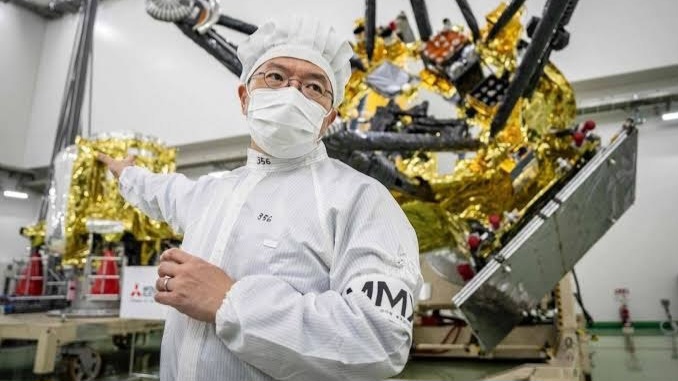
Japanese scientists are preparing a mission to the moons of Mars to collect samples from the surface of these bodies, samples that may help understand the origins of the solar system and the emergence of life on Earth.
The Mars Mound Exploration Mission (MMX) is scheduled to launch in the coming months from the Tanegashima Space Center in Japan; the spacecraft will remain in orbit around Mars for about three years and attempt to land on the moon Phobos.


The spacecraft is expected to collect at least 10 grams of samples from the surface of Phobos, and a French-built rover will conduct surface surveys; the samples are expected to be returned to Earth in a capsule around 2031.
The Japan Aerospace Exploration Agency (JAXA) hopes the mission will shed light on how the moons of Mars formed; whether they were created by a large impact with Mars or whether they were asteroids captured by Mars’ gravity.
Scientists say that studying Phobos and Deimos, two moons of Mars, could provide new information about the transport of water, organic matter, and elements essential for the formation of life on rocky planets.
This mission is being carried out in collaboration with the French and German space agencies, NASA, and the European Space Agency, and could pave the way for using Phobos as a natural space station for future human journeys to Mars.